What if: Operation Sealion, summary of an exercise held in 1974.
 In 1974 a major wargame conducted at Royal Military Academy Sandhurst in 1974 was held. Its aim was find out what might have happened had Nazi Germany launched Operation Sea Lion, their planned invasion of southeast England during World War II, in September 1940. The wargame was organized by the Daily Telegraph and Dr Paddy Griffith from the Department of War Studies at Sandhurst. The British umpires were Air Chief Marshal Christopher Foxley-Norris, Rear Admiral Teddy Gueritz and Major General Glyn Gilbert. The German umpires were General Adolf Galland (air), Admiral Friedrich Ruge (naval) and General Heinrich Trettner (land). After the game's conclusion, the umpires unanimously concluded that the invasion was a devastating defeat for the German invasion force.
 ScenarioThe game was played using a scale model of southeast England, the English Channel, and northern France. Available troops and resources were based on known plans from both sides, and weather conditions were based on contemporary British Admiralty records that had, until then, never been published.Assumptions- The German military had taken until September to assemble the shipping necessary for a Channel crossing- The Luftwaffe had not established air supremacy.- The Luftwaffe had continued to bomb London.- The Germans had only converted river barges available as transport ships.- The invasion fleet was largely unmolested in the crossing.Orbats of the British and German forcesHitler's Directive No.16Hitler's Directive No.17Kriegsmarine – List of Vessels at Embarkation PortsKriegsmarine – List of Vessels converted and collected in the designated assembly areas for Operation SealionKriegsmarine – List of Vessels available for Operation SealionKriegsmarine – Intelligence Report on the Royal NavyKriegsmarine – Fleet ListRoyal Navy – Intelligence Report on German NavyRoyal Navy – Fleet ListInvasion timeline (September 22nd 1940 to September 28th 1940)
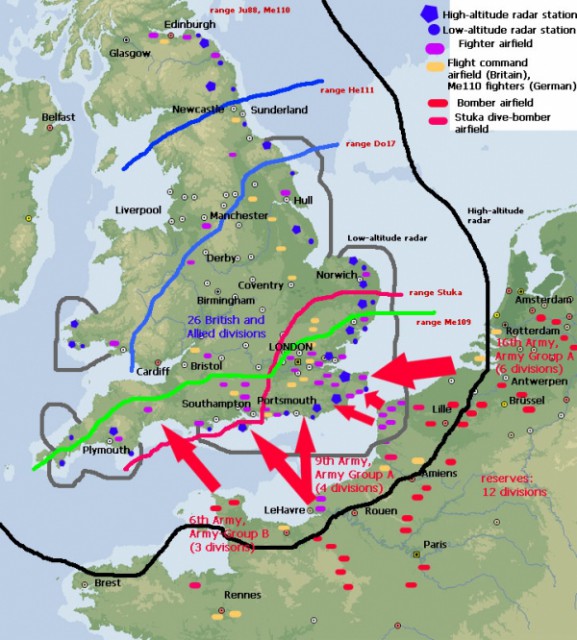 22nd September – morningThe first wave of a planned 330,000 men hit the beaches at dawn. Elements of 9 divisions landed between Folkestone and Rottingdean (near Brighton). In addition 7th FJ Div landed at Lympne to take the airfield.The invasion fleet suffered minor losses from MTBs during the night crossing, but the RN had already lost one CA and three DDs sunk, with one CA and two DDs damaged, whilst sinking three German DDs. Within hours of the landings which overwhelmed the beach defenders, reserve formations were despatched to Kent. Although there were 25 divisions in the UK, only 17 were fully equipped, and only three were based in Kent, however the defence plan relied on the use of mobile reserves and armoured and mechanised brigades were committed as soon as the main landings were identified.Meanwhile the air battle raged, the Luftwaffe flew 1200 fighter and 800 bomber sorties before 1200 hrs. The RAF even threw in training planes hastily armed with bombs, but the Luftwaffe were already having problems with their short ranged Me 109s despite cramming as many as possible into the Pas de Calais.22nd – 23rd SeptemberThe Germans had still not captured a major port, although they started driving for Folkestone. Shipping unloading on the beaches suffered heavy losses from RAF bombing raids and then further losses at their ports in France.The U-Boats, Luftwaffe and few surface ships had lost contact with the RN, but then a cruiser squadron withsupporting DDs entered the Channel narrows and had to run the gauntlet of long range coastal guns, E-Boats and 50 Stukas. Two CAs were sunk and one damaged. However a diversionary German naval sortie from Norway was completely destroyed and other sorties by MTBS and DDs inflicted losses on the shipping milling about in the Channel. German shipping losses on the first day amounted to over 25% of their invasion fleet, especially the barges, which proved desperately unseaworthy.23rd Sept dawn – 1400 hrs.The RAF had lost 237 planes out 1048 (167 fighters and 70 bombers), and the navy had suffered enough losses such that it was keeping its BBs and CVs back, but large forces of DDs and CAs were massing. Air recon showed a German buildup in Cherbourg and forces were diverted to the South West.The German Navy were despondant about their losses, especially as the loss of barges was seriously dislocating domestic industry. The Army and Airforce commanders were jubilant however, and preperations for the transfer of the next echelon continued along with the air transport of 22nd Div, despite Luftwaffe losses of 165 fighters and 168 bombers. Out of only 732 fighters and 724 bombers these were heavy losses. Both sides overestimated losses inflicted by 50%.The 22nd Div airlanded successfully at Lympne, although long range artillery fire directed by a stay-behind commando group interdicted the runways. The first British counterattacks by 42nd Div supported by an armoured brigade halted the German 34th Div in its drive on Hastings. 7th Panzer Div was having difficulty with extensive anti-tank obstacles and assault teams armed with sticky bombs etc. Meanwhile an Australian Div had retaken Newhaven (the only German port), however the New Zealand Div arrived at Folkestone only to be attacked in the rear by 22nd Airlanding Div. The division fell back on Dover having lost 35% casualties.Sep 23rd 1400 – 1900 hrsThroughout the day the Luftwaffe put up a maximum effort, with 1500 fighter and 460 bomber sorties, but the RAF persisted in attacks on shipping and airfields. Much of this effort was directed for ground support and air resupply, despite Adm Raeders request for more aircover over the Channel. The Home Fleet had pulled out of air range however, leaving the fight in the hands of 57 DDs and 17 CAs plus MTBs. The Germans could put very little surface strength against this. Waves of DDs and CAs entered the Channel, and although two were sunk by U-Boats, they sank one U-Boat in return and did not stop. The German flotilla at Le Havre put to sea (3 DD, 14 E-Boats) and at dusk intercepted the British, but were wiped out, losing all their DDs and 7 E-Boats.The Germans now had 10 divisions ashore, but in many cases these were incomplete and waiting for their second echelon to arrive that night. The weather was unsuitable for the barges however, and the decision to sail was referred up the chain of command.23rd Sep 1900 – Sep 24th dawnThe Fuhrer Conference held at 1800 broke out into bitter inter-service rivalry – the Army wanted their second echelon sent, and the navy protesting that the weather was unsuitable, and the latest naval defeat rendered the Channel indefensible without air support. Goring countered this by saying it could only be done by stopped the terror bombing of London, which in turn Hitler vetoed. The fleet was ordered to stand by.The RAF meanwhile had lost 97 more fighters leaving only 440. The airfields of 11 Group were cratered ruins, and once more the threat of collapse, which had receded in early September, was looming. The Luftwaffe had lost another 71 fighters and 142 bombers. Again both sides overestimated losses inflicted, even after allowing for inflated figures.On the ground the Germans made good progress towards Dover and towards Canterbury, however they suffered reverses around Newhaven when the 45th Div and Australians attacked. At 2150 Hitler decided to launch the second wave, but only the short crossing from Calais and Dunkirk. By the time the order reached the ports, the second wave could not possibly arrive before dawn. The 6th and 8th divisions at Newhaven, supplied from Le Havre, would not be reinforced at all.Sep 24th dawn – Sep 28thThe German fleet set sail, the weather calmed, and U-Boats, E-Boats and fighters covered them. However at daylight 5th destroyer flotilla found the barges still 10 miles off the coast and tore them to shreds. The Luftwaffe in turn committed all its remaining bombers, and the RAF responded with 19 squadrons of fighters. The Germans disabled two CAs and four DDs, but 65% of the barges were sunk. The faster steamers broke away and headed for Folkestone, but the port had been so badly damaged that they could only unload two at a time.The failure on the crossing meant that the German situation became desperate. The divisions had sufficient ammunition for 2 to 7 days more fighting, but without extra men and equipment could not extend the bridgehead. Hitler ordered the deployment on reserve units to Poland and the Germans began preparations for an evacuation as further British attacks hemmed them in tighter. Fast steamers and car ferries were assembled for evacuation via Rye and Folkestone.Of 90,000 troops who landed on 22nd September, only 15,400 returned to France, the rest were killed or captured.
Read more: http://alternate-timelines.proboards.com/thread/1045/operation-sealion-summary-exercise-held?page=1#ixzz4WxTiiD26
The Invasion of America, 19?? (1935 Scenario for Invasions via Canada, Mexico and the Caribbean)
Even before WWII, the American military and variously-aligned think-tank subsidiaries had for years hypothesized United States invasion scenarios, these where know as the United States color-coded war plans. Lesser known are the United States military’s preparation for the invasion of America.  This two-page spread was published by Fortune Magazine in September 1935 and it was undoubtedly generated by a number of causes, not the least of which was the rearming of Nazi Germany, which could theoretically cause some amount of concern in semi-fortress America. It was also an opportunity for Chief of Staff General Douglas MacArthur to whip up a little hell in Congress for the federal government to give the military some more money so that there was more to the “fortress” part of America than two oceans. Basically the plan seems to call for a standing, ready army of specialist forces that were agile and highly trained, a large network, of anti-aircraft batteries and detection areas, and of course a large buildup of the Army Air Force. The most prominent feature (besides the black invasion routes) are the terribly antiquated (even for 1936?) depictions of coastal defense canons. Perhaps this was disingenuous to include them with such flair, what with the main point of the article lending itself towards air invasion, but there they are, protecting the American coastline from a ripping adventure from the sea. But as we can see the successful invasion routes are coming from odd places—from Alaska, Canada, the Caribbean) against which the United States seemingly had no defense. This was especially true in the Pacific Northwest (“here defense system is weak”) where America was entirely susceptible to attack and invasion “from army basing in Alaska”. The rest of the west coast didn’t fair so well, though the only other direct threat was from “25,000 able-bodied male Japanese…Californians suppose they have secret arms and drill at night in dark halls”.The southwestern and southern California areas were relatively secure, except in the case of an enemy capturing Mexico; then, “an attack here would almost certainly be launched, in conjunction with one against San Antonio”. I guess there would be long intrigue, much preparation and enormous effort to attack and secure Mexico, and I’m assuming that the thinkers behind constructing this map assumed that the U.S. would be doing nothing during this prolonged period of time. map showing attacks on the West coast of America
Map showing attacks on the middle of the United states
 The attack on America in the Gulf would ostensibly come from Mexico and “an enemy basing in the Caribbean”, with a central interest in Birmingham and Norfolk. But the main thrust coming to the United states from unnamed horribleness would be coming through the St. Lawrence and points east in Canada, swooping down on Lake Champlain, the Mohawk Valley, Troy, Buffalo and Detroit. I know that there were bigger industrial concerns in these places in 1936 than there are now, but, well, my god there would be better places to begin an attack on the U.S. than from Montreal and Toronto.In all of this I see that the industrial northeast is left alone, save for a “feint” attack to dislodge resources and attention away from the movement against the Virginia coast. There’s the navy yard and industry and shipping and etc. there, but it would seem a terrible waste to attack here rather than a much juicer and more northerly series of prizes. Map showing attacks on the East coast of America

Read more: http://alternate-timelines.proboards.com/thread/631/1935-scenario-invasion-america#ixzz4WxOnkMBF
What if: Battle of Atlantic and the Type XXI
 With more hope than sense, Germany had more than 1,900 Type XXI and Type XXIII submarines under construction or on order on the last day of the European war.The whole point about the XXI was that it was invisible to radar. The 10 cm radar sets available in 1943 had a very hard time picking up the large ball valve snorkel head of the XXI. The smaller T-valve heads which were in development could not be seen by 1943 radar and were very hard to find with 1945 radar. The XXI was virtually invisible on the march.The 300 U-boat scenario could not have won the war. It was simply not feasible at the time when it could have won the Battle of the Atlantic (before 1941) and it was inadequate to win once it was feasible (1941).If you look at the constraints put on U-boat production in the 1930s, there is no way to get to 300 U-boats in 1939 or 1940. Under the treaty of Versailles, Germany was not allowed any submarines, so the Germans did some U-boat design work for other countries during the 1920s and early 1930s to keep up with the state of the art. Hitler was afraid of various treaty obligations, so he waited until 1935 to build his first small U-boats which were almost assembled from kits. The first Type II was launched is June 1935 and 13 more followed until the end of the year. Production peaked in 1936 with 10 Type II, 2 Type I and 9 Type VIIA. A single Type VIIA was launched in 1937.The U-boat building program was initially hampered by the British-German naval treaty which in 1937 allowed Germany 31,500 standard tonnes of U-boats. The standard tonne was related to the actual displacement. The Type II had 250 standard tonnes, the Type VII was 500, the later Type IX was 740 and the Type I was 712, which gives a total U-boat fleet of 12,424 standard tonnes in mid 1937. In addition, there were 8 Type IX A and 11 Type VIIB under construction or ordered totaling another 11,420 standard tonnes. The make up of the remaining 7600 tonnes were hotly disputed in mid 1937. Doenitz wanted more Type VII and the admirals wanted more long range fleet boats, the Type IX.The tonnage problem was largely solved when further negotiation with Britain at the end of 1938 increased the German tonnage to 70,000 standard tons, although this was to be done in stages over several years. This meant that Germany would be limited to a fleet of about 120 - 150 U-boats, depending on type mix, on reaching the final stage some time around 1943. Plan Z called for 174 U-boats at the end of 1943, which was already over the limit.On September 1, 1939, Germany had 57 U-boats in operation: 2 Type I, 30 Type II, 10 VII A, 8 VII B and 7 IX which totaled 23,100 standard tons. This was well below the 1937 allowed maximum and can be taken as a clear sign that Hitler was not expecting a war with Britain in 1939. Germany produced 7 more U-boats in 1939 and 54 in 1940, with losses of 35 during that period.If the Germans had used every loophole in the naval treaty with Britain and stretched things to the breaking point, they may have had around 90 U-boats in September 1939 and maybe as many as 150 by end 1940. This would have been most unpleasant for the British, but it would not have been decisive. In order to get the required 300 U-boats by end 1940, the shipyards would have had to set the stage for flat out production already in 1937/38 at a time the tonnage extension was not yet negotiated. Hitler would only have authorized this clear breach of the treaty if he had known he would have to fight the British when he attacked Poland. If he had known that, I am not at all sure he would have invaded Poland in 1939.If you turn this around and assume the Germans more or less stick to the naval treaty through 1939, bend the rules in 1940 and cheat in 1941, then they get to the 300 U-boats some time in the second half of 1941. Note this was not in Plan Z. Starting the war in Sept./Oct. 1941 has all sorts of advantages, but lets stick to U-boats. If we look at potential British naval rearmament scenarios we already have a problem because the invasion of rest Czechoslovakia historically started serious British rearmament. In order to keep the British quiet, this March 1939 invasion would have to be postponed, say to spring 1941 or even to coincide with the invasion of Poland. In our scenario, British intelligence will probably pick up a violation of the treaty some time in 1941 at the latest. Note the Germans are already technically in violation of the treaty timetable in 1940. Thus the British are probably making adjustments to their ASW investments by spring/summer 1941. Also note they have developed the cavity magnetron by now.The shipping losses in the first 6 months of this scenario would be dramatic. If we scale up the historic losses to 300 U-boats, the British lose around 8 million tons of merchant shipping which was around 20% of the available western fleet (estimated at 40 million tons) in the first 6 months of the war. Note the total loss would be higher since we are not considering losses due to surface ships, airplanes and other Axis countries. Historically a force of 20 - 25 ocean going U-boats sank around 800,000 tons from Sept 1939 through Feb. 1940. In our scenario the ocean going fleet would be about 10 times bigger. One can argue that the sinking efficiency of such a large U-boat fleet would be less than for a fleet of 20 - 25 U-boats, but even so, the losses would be dramatic. Also, if we apply the same U-boat loss rate per million tons sunk, then we get to around 100 U-boats lost between Sept. 1941 and Feb. 1942, hardly a cheap victory. Historically, the best U-boat statistics were achieved in the spring and summer of 1940 when the loss rate was less than 5 U-boats per million tons sunk and the efficiency was averaging around 10,000 tons sunk per U-boat per month. This was the time the U-boats had their act together, but the British did not. By 1941 the efficiency was below 2,000 tons/month and the U-boat losses were back to 1939 levels.Under the postulated conditions, the British get their ASW act together rather faster than they did in 1940 so German losses start increasing instead of decreasing. On the other hand, German production would be over 200 U-boats per year, compared to only 54 in 1940. Let us assume the shipping loss rate continues on as in the first 6 months and the U-boat losses increase slightly. The end result is another 8 million tons sunk and say 120 U-boats lost from March - August 1942, so the size of the U-boat fleet is barely keeping even. This would be the optimistic version. It is also quiet possible that the efficiency goes down in the second 6 months. In any event, it is unlikely that more than 15 million tons are sunk in the first year with a loss of around 200 - 250 U-boats. Historically almost 19 million tons were lost to end 1942 due to all causes. Obviously the loss of say 12 - 15 million tons of merchant shipping in the first year will have a much bigger effect than losing 19 million tons over 3 1/3 years. It may have been enough to throw Britain out of the war or it may not have been.Once we reach the fall of 1942, the U-boat are in a very similar position as they were historically. At that time efficiency was around 2,000 tons/month and losses were around 20 U-boats per million tons, a no win situation, and the situation could only get worse.The bottom line on the 300 U-boats is that they could realistically have been available at the beginning of the war assuming the war starts in Sept./Oct. 1941. These 300 U-boats would have caused massive losses in the first year, at massive cost to themselves, and then found themselves in a losing scenario because of technical deficiencies. It is possible, but not likely that they decide the war in that first year.Now assume the XXI project is two years ahead of itself. This is not a simple premise since the 1943 XXI would not be the same as the 1945 XXI which was the product of the prevailing chaotic conditions. The workmanship would be better and the mess with the hydraulic system would probably not have happened since the 1943 XXI would still have used electric motors. It would have been a higher quality boat with a lot less problems. Further, the crew training program would have been undisturbed by enemy ASW in the Baltic. Also not that snorkel technology would have to be 2 years ahead of itself, so there was scope for a small, radar invisible T-valve snorkel down the road.What would have happened if about 100 of these 1943 XXI had been operational by the summer of 1943? They would have sunk a lot of ships and would probably have torn up the odd convoy. If we assume a production of 20 XXI/month and a loss rate of 10 - 15 per million tons sunk, we wind up being able to sink 1.3 - 2 million tons per month and still keep up the number of U-boats in the field. The loss rate of 10 - 15 per million tons is reasonable when one considers the way the XXI would operate. It would be invisible to radar since it never surfaces and the snorkel head is very hard to find, so losses while enroute to station would be minimal. It carried 23 torpedoes and had a fast reload system which would have allowed at least two attacks on a convoy before being found. So the XXI gets in something like 6 kills with 12 torpedoes before it has to dive away. With some luck, they could get off 18 torpedoes which would give around 9 kills. A single XXI attack would result in the sinking of 30,000 - 50,000 tons and the XXI probably has an even chance to get away. Note it can run for 11 hours at 10 knots, which is more than adequate for keeping up with a slow convoy. So far we are working with standard torpedoes, no Lerche.The big problem with winning the Battle of the Atlantic becomes finding the convoys. The XXI was capable of finding its own targets out to a distance of around 30 NM using sonar and it could probably hear a battle 60 or even 90 NM away. The best way to use them would have been under radio silence for the whole voyage and that would have been the end of ULTRA. However, it is doubtful that Doenitz would have done that. He would most likely have continued on with all the chit chat, although that may have tipped him off to ULTRA since a lot of XXI would have survived the attempts to sink them enroute and also they would have picked up the attempts to reroute convoys. I would think that given a year, Doenitz would have found ways to minimize the effect of both HF-DF and ULTRA. Since the XXI could have operated in a high threat area, it could have operated close to the western approaches and picked up its targets relatively easily.This does not answer the question of how many ships get sunk. In order to win the Battle of the Atlantic, the objective would have had to be 15 - 20 million tons per year, which was Allied production plus a modest reduction in the total pool. Historically, the U-boats sank 5.8 million tons in 1942, their best year, out of total Allied losses of 8.2 million tons. The XXI would have had to manage about 3 times that, rather unlikely given only the XXI. If we throw in wire guided torpedoes like Lerche, the numbers start to look better since the XXI can now bite back hard against pursuing ships. And so we find ourselves on that slippery slope of “What ifs”.The XXI by itself in 1943 would most likely not have resulted in a draw or a German win, but in a longer war. However, it was a vital ingredient in any German draw/win scenario. The other vital ingredients were an earlier appearance of jet aircraft, notably the Me 262, and the death of Hitler by 1943. With the Me262 in control of the air over the Reich in 1943, the XXI doing major damage in the Atlantic and the generals running the war without Hitler’s interference, a draw was quite possible. In this sort of scenario, the Americans would have had a tough time delivering an atomic bomb in the face of German air superiority.
What if: Operation Unthinkable, Churchill’s plan to start World War III
 On May 8, 1945, as people everywhere celebrated the end of World War II, one gloomy figure was planning to start World War III. The ink had barely dried on Germany’s surrender document when British Prime Minister Winston Churchill asked his War Cabinet to draw up a plan to invade the Soviet Union.The gobsmacked generals were asked to devise means to “impose upon Russia the will of the United States and the British Empire”. Churchill assured them the invasion would be led by the United States and supported by the defeated German Army.Churchill’s belligerence was due to several factors. In Winston’s War, Max Hastings writes Churchill’s satisfaction at seeing the downfall of the Nazis was “almost entirely overshadowed” by Russian victories in Eastern Europe.By 1945, the USSR was vastly stronger and Britain a lot weaker than Churchill had anticipated. As he remarked at the Yalta Conference in February 1945: “On one hand the big Russian bear, on the other the great American elephant, and between them the poor little British donkey.”Secondly, Churchill’s stance against the Soviets hardened after he came to know about the success of the American atomic bomb programme. According to Alan Brooke, Britain’s Chief of Army Staff, Churchill told him at the Potsdam Conference in July 1945: “We can tell the Russians if they insist on doing this or that, well we can just blot out Moscow, then Stalingrad, then Kiev, then Sevastopol.”Finally, following Moscow’s barring of British representatives from Prague, Vienna and Berlin, as well as Stalin’s decision to paint Poland red, the British leader’s misery magnified.Thinking the UnthinkableAsked to prepare for war just days after the end of the bloodiest conflict in history, the British generals thought the Prime Minister had really lost it. Brooke wrote in his diary: “Winston gives me the feeling of already longing for another war.”The generals drew up a plan, appropriately codenamed Operation Unthinkable (full report "Operation Unthinkable: 'Russia: Threat to Western Civilization,'" British War Cabinet, Joint Planning Staff), which proposed Western forces attack the Soviets on a front extending from Hamburg in the north to Trieste in the south.The War Cabinet listed out the total allied strength in Europe on July 1, 1945: 64 American divisions, 35 British and Dominion divisions, 4 Polish divisions, and 10 German divisions. The German divisions were purely imaginary because after the mauling they received from the Russians, the surviving soldiers were in no hurry to fight. At most, the allies would have mustered 103 divisions, including 23 armoured ones.Against this force were arrayed 264 Soviet divisions, including 36 armored. Moscow commanded 6.5 million troops – a 2:1 advantage – on the German border alone. Overall, it had 11 million men and women in uniform.In aircraft, the Allied Tactical Air Forces in North West Europe and the Mediterranean consisted of 6,714 fighter planes and 2464 bombers. The Soviets had 9380 fighter aircraft and 3380 bombers.A battle map that show the final positions of the allied and Soviet armies at the end of World War II
 Sizing up RussiaAs the Germans had discovered, war against Russia was certainly not a walk in the park. The War Cabinet stated: “The Russian Army has developed a capable and experienced High Command. The army is exceedingly tough, lives and moves on a lighter scale of maintenance than any Western army, and employs bold tactics based largely on disregard for losses in attaining its objective.“Equipment has improved rapidly throughout the war and is now good. Enough is known of its development to say that it is certainly not inferior to that of the great powers.“The facility the Russian have shown in the development and improvement of existing weapons and equipment and in their mass production has been very striking. There are known instances of the Germans copying basic features of Russian armament.”The assessment, signed by the Chief of Army Staff on June 9, 1945, concluded: “It would be beyond our power to win a quick but limited success and we would be committed to a protracted war against heavy odds. These odds, moreover, would become fanciful if the Americans grew weary and indifferent and began to be drawn away by the magnet of the Pacific war.”Operation Lusty and Air SuperiorityOperation LUSTY (LUftwaffe Secret TechnologY) was the United States Army Air Forces operation to capture and evaluate German aeronautical technology and scientific advances. Using captured German jets and blueprints, the Americans and British improved their own jet aircraft and made rockets. Had Unthinkable been launched, American and British jet fighters such as the American P-80 and the British Meteors along with German jet fighters coming out of the revitalised factories would easily win air superiority over Soviet air space, as even their most modern aircrafts, the Yak-3s and La-9s would be outclassed. With air superiority, American and British heavy bombers would be able to devastate supply lines and fighter-bombers would be able to strike Soviet positions at will. Without the British sale of the Rolls-Royce Nene jet engine to the Soviets, they would be hard pressed to make their own jet engine and would be unable to recover their airspace.Ground Forces and EquipmentNow, maintaining air superiority is good and all, but it won’t matter if your line still gets smashed, so let’s compare the Soviet and Allied materiel they would’ve had.In terms of small arms such as machine guns and rifles, the Allied and Soviet armies would be pretty evenly matched. But if the Allies fully revive German industry and adopt their designs, they would be able to use advanced German weapons such as the Sturmgewehr 44s, which would tip the odds in this category in favour of the Allies.Tanks are harder to compare since they had different doctrines, but purely in terms of armament and armour, the Soviets would beat the Allies in this category, at least at first. IS-2s and IS-3s would outclass their lighter Allied designs, such as Shermans and Cromwells, but as the war drags on, they would be able to field counters such as Pershings, T-32s and Britain’s Challengers. In addition to American and British designs, with Germany’s revitalised industry, they can also use German late-war designs such as Tiger IIs and Panthers to fight the Russians. Though in the future, the Soviets would also be able to use better tanks like the T-54s and the IS-4s, so in the end, both sides’ tank forces would be equally matched.While Soviet and Allied commanders are both good, the Soviets would probably have the upper hand due to their willingness to take large casualties to accomplish goals. The Allied command would probably be less willing. That said, the Allies have many great generals at their disposal, and with resurrected German formations, they can also gain the experience of German field marshals like Guderian and Manstein on optimal ways to fight the Russians.The Soviets would also have a harder time supplying their troops, as their supply route goes from Russia to Poland to East Germany, while the British and American can supply their troops from Britain to France to West Germany, which in comparison, has better infrastructure. In addition, the Soviet supply line would also be bombed by Allied bombers, making it even harder for the troops.Even so, in terms of equipment and forces, both sides are around equally matched. Still, someone has to make the equipment for the troops to fight with.The Home FrontBy the end of WW2, Great Britain was heavily exhausted and it would be hard to get the British to fight the Soviets. So Churchill would need to find a way to bolster the people’s resolve. But even so, the British by themselves wouldn’t be able to make enough equipment to fight and will have to rely on the American war machine. Americans, after knowing the horrors of the Red Army and what they did to civilian populations would be willing to support the industrial effort.For the Russians, however, the production of goods will be a harder thing, as in the latter part of WW2, they were supplied by American Land-Lease goods. Now that they were at war, industrial goods to help manage factories, foodstuffs, trucks and other vehicles would be cut off, meaning that the Soviets would have to make all of those.In addition, though the Russian industry was at that point past the Ural Mountains, heavy strategic bombers such as B-29s can fly from air bases in occupied Japan to to bomb them.Though with enough sticks and propaganda, the Soviet war machine will still crank on, but the Americans would probably outproduce them. In addition, he American’s craftsmanship and quality would be better than the Soviets’.NukesHere’s the big one, the atomic bombs. By the start of Unthinkable, America could already make atomic bombs and the Soviets knew this after Hiroshima and Nagasaki, but they don’t have atomic weaponry yet, so they’ll be at a disadvantage. Remember, Allied airpower would be able to defeat the Soviet Air Force and so delivering the bombs wouldn’t be much of an issue, especially considering that B-29s perform well at high altitudes, so the Soviets would be hard pressed to catch them. Long range F-82s would be able to escort the bombers. Depending on how many atomic bombs America can make, they could completely destroy key Russian cities like Moscow and Kiev. If leaders like Stalin dead, the Soviets would need to find new leaders just as ruthless and just as efficient as Stalin was, or they will have to go to the bargaining table with the Allies.The OutcomeSo who would win and what would the result be? It would be a grueling, uphill battle for the Allies, especially because they’d have to go into East Germany then Poland and then into Russia to make them surrender. The casualties on both sides would be heavy,but in my opinion, the Allies would probably win against Soviet Union, despite the numerical disadvantage. Even if they can’t force the Soviets to agree to every decision, they would be able to accomplish some of their war aims. Nevertheless, despite the victory, Europe would be in ruins and the United Kingdom on the verge of bankruptcy. America would, like in our timeline, help rebuild Europe and finance it.What if 'Operation Unthinkable' Happened (YouTube)
What if: German victory in the Battle of Jutland
 A century ago, the two greatest fleets of the industrial age fought an inconclusive battle in the North Sea. The British Grand Fleet and the German High Seas Fleet fielded a total of fifty-eight dreadnought battleships and battle cruisers, ships over the twice the size of most modern surface combatants. Including smaller ships, the battle included 250 vessels in total.The two fleets fought to a draw, with the Germans inflicting more casualties, but still being lucky to escape alive. The Grand Fleet could very easily have annihilated the Germans, an outcome which, however tragic, would not have moved the needle on the rest of the war. But what if the Germans had won?The Battle Situation
First things first, how could the Germans have won? The High Seas Fleet faced very tough odds at Jutland. It only enjoyed a numerical advantage near the opening stages of the battle, when the German battle cruisers (commanded by Adm. Franz von Hipper) drew a contingent of British battle cruisers and fast battleships (commanded by David Beatty and Hugh Evan-Thomas) within range of Reinhard Scheer’s German battle line.We can imagine a different outcome if we alter some of the events at the opening of the battle. HMS Lion, the flagship of the British battle cruiser squadron, nearly exploded in the early minutes of the battle, after suffering a devastating hit from SMS Lutzow, Hipper’s flagship. The early detonation of Lion would have allowed the Germans to build advantage upon advantage; guns targeted at the lead battle cruiser would have focused on the next in line, and so forth. The British lost two battle cruisers during this stage anyway, and it is easy to imagine the loss of Lion leading to disarray in the British squadron. At the extreme, the concentration of German gunfire on fewer ships, and the lack of command and control on the part of the British, could have led to the loss of all six British battle cruisers and four fast battleships (all four of the latter would serve capably in World War II, meaning that a German victory might have had long-term effects).To be clear, this would have been an astonishing German victory; the destruction of ten British capital ships would have shocked the world. But Scheer, the overall German commander, always believed that he could have won a great victory by engaging the Grand Fleet as it entered line formation to his north. Frankly, however, it’s hard to see how this happens; the German were themselves disordered, and Admiral John Jellicoe brought twenty-four dreadnoughts and three battle cruisers to the party.But let’s be generous; in the chaos, the Germans might have isolated and hammered another three to five British capital ships before escaping back to Kiel. If we allow the additional destruction of three dreadnoughts and two battle cruisers, this leaves the Germans with what amounts to a 15–0 scorecard—a truly devastating success on par with the greatest naval victories in history.The Aftermath
But what would this have won? Such a victory would have substantially cut the British advantage in the North Sea. The Royal Navy had two dreadnoughts and one battle cruiser in reserve, and two more battle cruisers and three dreadnoughts would enter service before the end of the year. The Germans had one battleship in reserve, and would shortly commission one new battle cruiser and two new battleships. By the end of the year, the Germans would have eighteen battleships and six battle cruisers, the British twenty-six battleships and four battle cruisers. In short, the remnant of the Grand Fleet could pose a credible threat to even a victorious High Seas Fleet.And Britain had allies.Seven French dreadnoughts operated in the Mediterranean, backstopping the Italian navy’s efforts to pin Austria-Hungary in the Adriatic. An emergency in the North Atlantic would likely have drawn them into support of the Grand Fleet. Further afield, Japan operated six dreadnoughts and four battle cruisers, almost all of outstanding construction. The Imperial Japanese Navy would eventually deploy a squadron in support of Entente operations in the Mediterranean, but in case of emergency London might have made the diplomatic concessions necessary to accessing the greater part of Japanese naval power.Finally, the United States had twelve dreadnoughts in the waiting, and Brazil would eventually contribute a pair of (poorly maintained) dreadnoughts to the cause. Both Brazil and the United States entered the war as a direct result of Germany’s unrestricted submarine warfare campaign, but a German victory at Jutland might have changed thinking in Washington and Rio de Janeiro. We will return to this question.Could German victory have shocked the British public into demanding an end to the war? Anything is possible, but maritime vulnerability drove anti-German sentiment in the prewar period, and there is little reason to believe that it would cause the British to throw in the towel in 1917. Moreover, the British public suffered similar (in fact, more devastating) setbacks in 1940 and 1941, and continued to support the fight.German Naval Activity Post-Jutland
Defeating the Grand Fleet would undoubtedly have taken a severe toll on the Germans; many ships would have taken months to repair. But the problem for the Germans ran deeper than battle damage.Imperial Germany built the ships of the High Seas Fleet for one purpose: to destroy the battlefleet of the Royal Navy. For this purpose they were good ships, but they offered little for other tasks. The ships of the High Seas Fleet lacked the range, habitability and underway replenishment techniques necessary to engage in a long-range raiding campaign, much less a sustained blockade of British ports.Moreover, the High Seas Fleet could not have broken the British blockade, which depended more upon Britain’s favorable geography than the power of the Grand Fleet. German ships could perhaps have escorted specific merchant vessels through, but the Royal Navy had global reach; if necessary, it could take those merchants before the Germans had a chance to escort them.The Germans could have engaged in more vigorous efforts to bombard the British coastline (especially with the gutting of the British battle cruiser force), although such bombardments would have had only a very marginal effect on the British economy. The High Seas Fleet could potentially have disrupted channel traffic for a while, forcing the British to rely more on France’s Atlantic ports, although this would have proven more an inconvenience than a real hardship.What about the effect on U-boats? The German high command reacted to Jutland by refocusing its efforts on submarine warfare, an attempt to strangle Britain out of the war. A major victory might possibly have delayed this decision, pushing back U.S. entry into the war. Although the submarine campaign created some perilous moments for the United Kingdom, it did not meaningfully degrade the effectiveness of the British Army in the field. Thus, a delay to U.S. entry might have bought the Germans more time to win the war in France.But this depends very much on U.S. reaction to a German victory at Jutland. Both presidential candidates in 1916 ran on peace platforms, making it unlikely that the United States would have reacted by immediately entering the war. However, a German victory might have shaken American confidence in British success, leading to additional support for the war effort. Overall, however, it is hard to argue that the success of the Germany surface fleet would have had as negative an effect in the United States as the resumption of submarine warfare.It helps to win battles, and the Germans would undoubtedly have derived some benefit from defeating the Royal Navy at Jutland. However, the Reich had much bigger maritime problems than the Grand Fleet alone; its disadvantageous geographic position made it difficult for Germany to take access international markets even under the best wartime conditions. Moreover, while Great Britain’s international position meant that it had responsibilities around the world, it could also draw on more global resources, including allies.Germany’s biggest advantage might have sprung from the confidence that it could, in fact, win battles at sea against the Royal Navy. This confidence might have forestalled the risky, and ultimately disastrous, gamble of unrestricted submarine warfare. The German offensive of spring and summer 1918 very nearly succeeded, despite the material and military support of the United States. Had the United States been less involved, Germany quite possibly could have prevailed.
